"The Wave"
Natural Disaster movie, "THE WAVE"
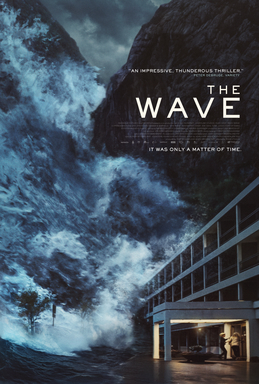
I chose the movie "The Wave" because it was on Netflix and looked interesting. It is based on a true story of a huge tsunami that hit a fjord in Norway 80 years ago. I didn't realize before starting the movie that it was in Norwegian and dubbed in English, which made the acting really unbelievable. I found myself laughing through the more intense scenes. Besides being a fairly bad movie, the concept of a tsunami caused by a rockslide is something I won't ever forget.

The movie takes place in a famous tourist destination, Geiranger, Norway (above). It looks absolutely spectacular. It is home to one of the most amazing fjords in Norway. Thousands of tourists visit this fjord every year, along with cruise ships throughout the summer months.
The village of Geiranger is always under threat from the mountain, Aknesfjallet, which could erode into the fjord. Right now, it has a 2300 foot long and about 100 feet wide crack. Each year that crack grows in size up to 15 centimeters. The mountain is very unstable! Eventually it will fall into the sea. When that happens, it could cause a huge tsunami that could potentially destroy the town. In fact, 80 years ago, this actually happened in Norway. There was a rockslide that caused a tsunami to hit the town of Tafjord in 1934. The wave was 209 feet high and it killed 40 people.
The movie starts with Kristian, a geologist who works at the monitoring station of Aknesfjallet. The moniter sensors had gone off indicating that groundwater from the mountain has disappeared. Kristian is worried about this and begs his colleagues to check it out. They tell him he's being paranoid and ignore the problem. Kristain can't let it go, so he goes back to the station and convinces his colleagues that the water is having an effect on the crevasse. He then takes a helicopter up the mountain to check the instruments only to find that the wires have been snapped. They raise the emergency level, but do not start evacuating people until they have more information. They decide lower some of the geologists into the crevasse of the mountain to investigate what is happening with the monitoring system. While they are in the crevasse, the mountain starts to quake and the rockslide starts, killing one of the workers. The rockslide is so massive that people in the village feel the quake of the earth as the rock slides into the water. Then the sirens sound. The people on the island know that they only have 10 minutes to make it high enough to be safe from the wave that is surely coming. There is pandemonium and major traffic jams as everyone in the village evacuates at once. The rockslide causes a 262 foot wave to rush to shore, drowning those who couldn't make it to safety in time. The rest of the movie is about Kristian trying to find his family and rescuing them from a flooded building.
 |
| Photo from the movie "The Wave" |
Tsunami's in general fascinate me and always have. The scene in the movie when the tsunami surges up to the coastline was spectacular and intense. I can not imagine how terrifying that would be to see in person. Thank heaven I live in Utah! I think the movie did an accurate job of showing what could happen if a large rock avalanche falls into the sea. It made me think about the chaos that it would cause if people weren't given enough advanced warning to evacuate either. "Landslide-generated tsunamis are much more locally limited than tsunamis produced by sea quakes, but they can be massively tall and devastating in the vicinity," says Hermann Fritz, an environmental engineer at the Georgia Institute of Technology.
Geiranger, Norway is now definitely on my bucket list of places I must see. It was good to learn that Aknesfjallet is the most monitored mountain in the entire world. They have state of the art monitoring systems in place to watch the mountain's every move. They predict that with these monitoring systems, they will be able to evacuate 5,000 residents from the villages with 72 hours of warning before the mountain falls. I can't wait to go see it in person!
Sources:
https://www.ngi.no/en/Contentboxes-and-structures/Reference-Projects/Reference-projects/Monitoring-and-modelling-of-the-Aknes/
Keller, E. A. and DeVecchio, D. E., 2015.Natural Hazards, Earth's processes as hazards, disasters and catastrophes. Fourth edition.
https://www.nature.com/news/huge-landslide-triggered-rare-greenland-mega-tsunami-1.22374
Comments
Post a Comment